

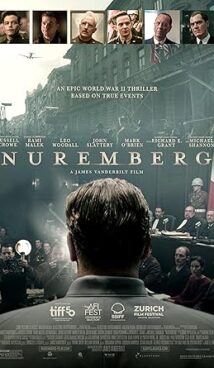
Nuremberg
- Russell Crowe, Michael Shannon, Rami Malek
- James Vanderbilt
- Drama, Biography, History
- November 7, 2025
- 2025
Synopsis
Short pooper
Göring (Russell Crowe) is found guilty of War Crimes and sentenced to death, but commits suicide by cyanide poisoning before his sentence is carried out. The rest of the defendants are sentenced to death, as well. Kelley (Rami Malek) writes and publishes a book about his Nuremberg experiences that becomes a failure and, plagued by it all, also commits suicide later on. The efforts of the Nuremberg trials would ultimately become the pillar for later tribunals against War Crimes.
Longer version
During the proceedings to interview Göring and determine how competent he is to stand trial, it becomes clear he is deliberately elaborating his answers, in order to extol the greatness of the Nazi efforts and make the Allied occupation of Germany look like a biased political plot. When the trial starts, an explicit film showing Nazi atrocities at the concentration camps is played in Court as part of the prosecution’s strategy, but Göring -who is barred from speaking in Court- later dismisses it as “staged” to an unnerved Kelley.
Kelley also comes to discover that Göring’s wife, Emmy (Lotte Verbeek), was accused of being part of the massive art theft overseen by Göring in occupied territories, and their daughter Edda (Fleur Bremmer) was sent to a convent to be protected from persecution. Moreover, Kelley finds himself in hot water when Lila (Lydia Peckham) publishes compromising confidential information he revealed to her in secret, for which Col. Andrus (John Slattery) fires him from his current position.
As Kelley is ready to catch a train to leave Germany, Sgt. Triest (Leo Woodall) reveals his Jewish origin, which caused the death of his parents, while his sister was able to flee to Switzerland, and warns Kelley that an example must be made of these Nazi defendants at all cost. This bolsters Kelley -as he was no longer in charge of the procedures against Göring- to pass on all his material to Jackson (Michael Shannon), who, in turn, due to his many years of inactivity in Court, almost botches the case against Göring with a poorly handled cross-examination. Göring, in turn, resorts to denying knowledge of crimes committed, giving vague and overdrawn answers to the questions, and deflecting the true intentions of his authorization of the FINAL SOLUTION as a purportedly misinterpreted “Complete Solution that aimed to just have Jews removed from Germany towards elsewhere, instead of exterminated, as they were”.
Göring’s mind games effectively get under Jackson’s skin and throw him off his game, which earns him a reprimand and demand of non-bias from the Judges. However, Sir Maxwell-Fyfe (Richard E. Grant) saves the moment by taking over the cross-examination and successfully cornering Göring into admitting his ongoing loyalty to Hitler and Nazism. As a result, a guilty verdict falls upon Göring and the rest of the indicted officials; they are all accused of War Crimes and sentenced to death by hanging.
Unfortunately, the day prior to when his execution is to take place, Göring chews and swallows a cyanide pill -a common way amongst Nazis to commit suicide, sometimes an entire family including children, thus escaping punishment for their deeds- and is found dead in his cell. Undeterred, Col. Andrus orders to carry on with the execution of the rest of the defendants, Streicher (Dieter Riesle) being the first.
The movie ends with title cards informing that a despondent Kelley, overcome by guilt, writes and publishes a book about his time in Nuremberg, called 22 CELLS IN NUREMBERG, but, due to the poor reputation that followed him upon his falling out from the trials, he has difficulty promoting it and it ends up being a failure; between this, him having become an alcoholic and plagued by the fears of another regime similar to Nazism coming to be in the future, he also commits suicide by a cyanide capsule in 1958; Triest reconnects with his sister, having her brought over to the United States; and the successful outcomes of the Nuremberg trials in prosecution, indictments and sentences, became the building block for later similar trials against War Crimes -nowadays mostly conducted, save for exceptions, out of the International Tribunal in La Hague, Netherlands-.